
When you change your hair color with hair dye, what exactly happens inside your hair? Is it simply a matter of “applying color,” or are there deeper chemical and structural changes? Understanding these aspects can help you make more informed choices about hair coloring products and better protect your hair and scalp health. This article will analyze in detail how hair dye changes hair strands from three perspectives: hair structure, hair dye ingredients, and its mechanism of action. It’s suitable for those curious about the mechanisms of hair coloring and for those who want a “safer/healthier hair coloring.”
Table of Contents
I. Basic Structure of Hair: Understanding the Three Main Layers of Hair
To understand how hair dye works, we first need to know what hair is like. A healthy hair strand is mainly composed of three layers:
- The cuticle—like roof tiles—overlaps and arranges itself to protect the internal structure from damage.
- The middle layer (cortex)—where most of the hair’s structure is located—determines the hair’s strength, elasticity, and color base.
- The innermost layer (medulla)—not all hairs have this; sometimes it’s empty, sometimes it’s a dense structure, and it doesn’t contribute much to hair coloring.
When hair is intact, the cuticles are closed, and the internal structure is well protected. Natural hair color is mainly determined by the natural pigments (melanin, chrysophyll, etc.) in the cortex. Color, shine, elasticity, and strength are all related to these three layers of structure.
Simply put: hair strands are like a multi-layered conduit—outer shell + contents + center—to change color, you must open the outer shell and go inside. That’s the “magic” of hair dye.

II. Basic Components and Classification
Different types of hair dye (permanent/semi-permanent/temporary) have different ingredients, but they all generally contain some “key players.” Understanding these players is key to seeing how hair coloring alters the hair.
Common components of typical permanent hair dye
- Alkaline agents (such as ammonia or ammonia substitutes) are used to temporarily lift the cuticles, causing the structure to “open up.”
- Oxidizing agents (usually hydrogen peroxide) are used to break down/dilute existing natural pigments, making room for new pigments.
- Dyes or color-developing precursors (such as p-phenylenediamine PPD/other oxidative dyes) enter the hair shaft and react with oxidants during the oxidation process to form new, stable pigment molecules.
- Additives/Regulators/pH Adjusters/Care Ingredients—These help the dye penetrate and stabilize the color while also soothing the hair and scalp from irritation caused by alkaline or oxidizing agents.
Semi-permanent/ammonia-free/temporary hair dye
These typically reduce or omit oxidizing/alkaline agents, instead using small molecule dyes that have already developed color or dye-coated materials that adhere only to the surface of the hair or the shallow cuticle gaps.
- The “damage/disruption” to the hair structure is relatively small.
- The color retention/stability is usually weaker, but it is more friendly to hair and scalp.
III. How hair dye “changes” hair strands—from the outer shell to the inside.
hair coloring is actually a major overhaul of the hair structure and pigments.
Step 1—Open the hair cuticles and enter the hair shaft
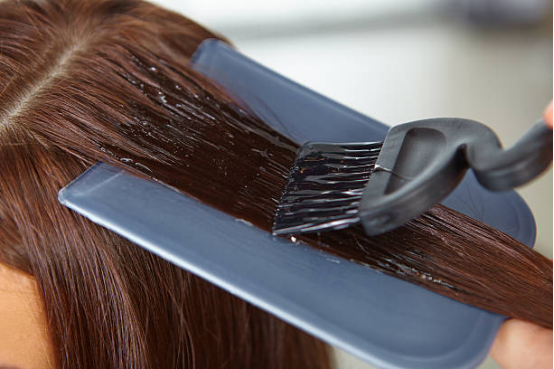
- When you apply hair dye to your hair, alkaline agents (such as ammonia) and/or oxidizing agents temporarily lift the hair cuticles on the outer layer of the hair shaft.
- This is equivalent to opening up the “protective shell” of the hair. The closed, overlapping scales are stretched open, like a tile being lifted up with a small gap.
- This opening process is necessary—otherwise, the dye cannot penetrate the cortex and will only remain on the surface of the hair, resulting in an unnatural color and short-lasting effect.
This process determines whether hair coloring can be applied “deeply” and also the extent of damage to the hair structure after coloring.
Step Two – Lighten the original pigment + Re-dye with new color
- For permanent hair dye, the next step is to lighten the natural pigment and replace it with a new pigment.
- Oxidizing agents (hydrogen peroxide) break down the natural melanin/chloasma in the cortex, causing the original natural hair color to lighten.
- At the same time, the dye/color precursor (such as PPD) enters the hair shaft and reacts in an oxidizing environment to generate new pigment molecules.
- These new pigment molecules are smaller, more stable, and longer-lasting than natural pigment particles and are less prone to fading.
From the outside, it looks like “hair has changed color after dyeing.” But structurally, it’s because the natural pigments have been “partially removed and replaced” with artificial pigments.
Step 3—Close the hair cuticles and stabilize new pigment.
After the color development is complete and the hair is rinsed and blow-dried, the hair cuticles will partially “reset”—the outer protective layer will once again cover the hair strands.
This closure process is crucial—it determines the stability of the new pigment and whether the hair quality is damaged. If the closure is incomplete or subsequent care is inadequate, it can lead to dull color, dry hair, breakage, and frizz.
IV. Differences in the impact of different types of hair dye on hair structure
Different hair dyes have vastly different effects on hair structure and texture. Understanding these differences will help you choose the right hair coloring method for your needs.
Permanent hair coloring/strong oxidative dyeing—the most “thorough” and also the most “intense.”
Advantages: Rich, long-lasting color with strong coverage.
Disadvantages: Greatest damage to hair. Due to the multiple processes of cuticle lifting, bleaching, oxidation, and color development, hair undergoes structural damage and protein and lipid loss and becomes dry and brittle.
- Frequent use of permanent hair dye, combined with perming/bleaching, can easily lead to breakage, split ends, and loss of hair elasticity.
- It can also irritate the scalp and hair follicles, especially if you have sensitive skin or existing scalp problems.
Therefore, if using permanent hair coloring, it is recommended to reduce the frequency of hair coloring, strengthen aftercare, and perform deep repair after coloring.
Semi-permanent/ammonia-free/weakly oxidative/temporary dyeing—gentle, but with limited effects.
Advantages: Less damage to hair structure, gentler on the scalp, and suitable for first-time hair coloring, temporary color changes, and color testing.
Disadvantages: Light color, fades quickly, not suitable for bleaching or drastic color changes.
This method is suitable for people who want to simply change their hair color, cover gray hair, or try a trendy color without damaging their hair.
V. Practical advice: How to maximize the effect and minimize the damage when using hair dye?
After understanding the structure of hair and the mechanism of hair dye, you can follow these suggestions to make “hair coloring” “” a safe and effective treatment, rather than a torment to your hair.
Recommendation 1: Choose the appropriate type of hair dye based on your hair type and needs.
- Want a stable, lasting, and complete change in hair color? → Choose a permanent hair dye, but control the frequency.
- If you want to experiment with colors, cover white areas, or create temporary changes, prioritize semi-permanent/temporary/ammonia-free/weakly oxidized dye.
Recommendation 2: Give your hair “buffering and recovery” time before and after hair coloring.
- Don’t dye your hair right after washing it. Letting your scalp’s natural oils help buffer the irritation.
- Wait at least 24–48 hours after dyeing before washing your hair, and use color-protecting shampoo/hair mask/conditioner.
- Regular deep conditioning/nutritional care replenishes damaged proteins and lipids.
Recommendation 3 – Reduce the frequency of hair coloring and avoid frequent chemical treatments.
- Permanent hair coloring, when done in conjunction with perming, dyeing, bleaching, or straightening, causes significant damage to the hair.
- If staining is necessary, allow at least several months between treatments, and intensify repair during this period.
Recommendation 4 – Pay attention to scalp health. Those with sensitive skin should use strong hair dyes with caution.
Long-term chemical irritation to hair and scalp can cause problems such as sensitivity, dryness, irritation, and flaking. Sensitive scalps should prioritize mild/semi-permanent/temporary hair dyes.
Conclusion: Understanding hair and rational hair coloring—let hair dye enhance your beauty, not harm you.
But this “magic” also means responsibility—responsibility for hair quality, scalp, and future hair health.
When you truly understand hair structure, hair dye ingredients, and the hair coloring mechanism, you can make more rational choices about hair coloring methods, control the frequency more carefully, and care for your hair more scientifically. That way, whether it’s a trendy color, a soft and natural look, or a temporary experiment, you can achieve the look you want instead of becoming the starting point for worsening your hair quality.